SPECIAL!!
Receive Up To 2 Weeks Free Base Rent On Select Apartment Homes!*
Tour Today!
*Base Rent. Minimum lease term applies. Other Cost and Fees Excluded. Restrictions apply. Offer may change.

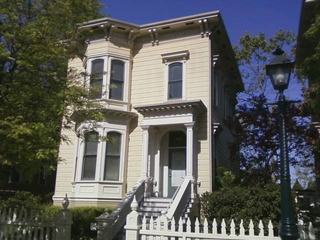
Photo Credit: Preservation Park
A recreated Victorian neighborhood tucked between skyscrapers, Preservation Park is one of Oakland’s most distinctive event destinations; a preserved pocket of Oakland’s architectural past, carefully rebuilt after nearly disappearing.
Preservation Park began not as an event destination, but as one of Oakland’s early upper-middle-class neighborhoods. In the late 1800s, families built ornate Victorian homes here (Queen Anne, Italianate, Stick Style) along narrow, tree-lined streets. For decades, the area thrived as an elegant residential district just west of downtown.
By the mid-20th century, however, the neighborhood had declined. Many homes were subdivided into boarding houses; several fell into disrepair. When redevelopment plans and a proposed freeway project threatened the area in the 1970s, only five original Victorian homes remained on their historic sites. The others faced demolition or relocation.
A grassroots community effort pushed back. Led by local residents and preservation advocates, the City of Oakland and the U.S. Department of Housing and Urban Development formed a public–private partnership to save the neighborhood’s surviving architecture. Dozens of endangered Victorian homes from around Oakland were moved onto the site, joining the originals and creating a concentrated historic district rather than letting these structures disappear.
Renovation and restoration work began in the early 1980s, with the goal of transforming the district into a campus for nonprofits, cultural organizations, and community gatherings. Progress stalled briefly in 1986 due to funding limitations and leasing challenges, but renewed federal and city support helped the project move forward. Bramalea Inc. was brought in to oversee redevelopment, restoration, and the long-term leasing strategy.
By 1991, the reconstructed Victorian village—now known as Preservation Park—was complete. It quickly became fully leased, and today it is owned by CMA Asset Managers Inc. and supported by the nonprofit Preservation Park Center Inc., which helps maintain its historic character and community-serving mission.
The result of this multi-decade preservation effort is a small, walkable neighborhood of sixteen Victorian-era homes set among lawns, gardens, and period-style street lamps. The restored buildings offer more than 55,000 square feet of office and meeting space, primarily serving nonprofits and small organizations whose work supports the Bay Area’s cultural, social, or environmental goals.
At the same time, Preservation Park has evolved into a beloved venue for community events—from weddings and receptions to conferences, fundraisers, and gatherings of all kinds. The charm lies in the contrast: ornate historic homes, manicured grounds, and quiet courtyards set right in the middle of Oakland’s urban core.
1. Is Preservation Park open to the public, or do you need a reservation?
Yes, it is open to the public.
Preservation Park is a public pedestrian space during normal daytime hours. People can walk through, enjoy the gardens, admire the Victorian architecture, eat lunch on the benches, or take photos.
The only times gates close are:
* during reserved private events
* during after-hours events
* occasionally for maintenance or special programming
It is not a traditional “park” with playgrounds or recreational amenities, but it is a publicly accessible historic district.
2. Is it primarily an event venue?
Yes—functionally, it operates largely as an event venue and office campus. The Victorian homes contain nonprofit offices, meeting rooms, and rentable event spaces such as Nile Hall, Ginn House, and Fountain Circle. Weddings, corporate retreats, fundraisers, and cultural events happen frequently.
The public can visit, but event rentals are the primary source of programming and revenue.
3. Can I walk in just to explore or take photos?
Generally yes, during open daytime hours, though certain areas may be roped off for events. People often come to enjoy the space for quiet walks and lunch breaks.
4. Is photography allowed?
Personal photography is fine; commercial photography typically requires a permit. Engagement sessions, professional shoots, or large setups often need to be scheduled.
5. What exactly is Preservation Park—an actual historic neighborhood or a recreation?
It’s both. Five buildings remain in their original location. Eleven additional Victorian homes were moved here from elsewhere in Oakland. Together, they form a reconstructed historic district designed to preserve and showcase late 1800s Victorian architecture.
7. Is there parking?
There is no dedicated parking lot. Visitors use street parking around the neighborhood and nearby downtown garages. Public transit is also recommended as it’s close to 12th St. BART and AC Transit.
8. Are the buildings actually used as offices?
Yes. Many are leased by nonprofits and small mission-driven organizations. The campus was intentionally structured to support community-benefit organizations whose work aligns with cultural, environmental, or social goals.
Preservation Park’s layout offers a range of indoor and outdoor spaces with distinct atmospheres, including:
More than a collection of Victorian buildings, Preservation Park is a testament to Oakland’s commitment to safeguarding its architectural history while giving it new civic life—a restored neighborhood that continues to serve the community through culture, collaboration, and celebration.